Skill Swap or Demonstration? Pick a Format for Sharing Know-How
Skill swap or demonstration: choose a format that matches participants’ experience, the skills on offer, and what people should be able to do afterward.
A skill swap works best when participants can teach one another; a demonstration works best when one person needs to show a process clearly. That distinction matters when a community group wants to share practical know-how without making newcomers feel they should already be experts. The format shapes who contributes, what people can learn, and whether the gathering leaves room for practice.
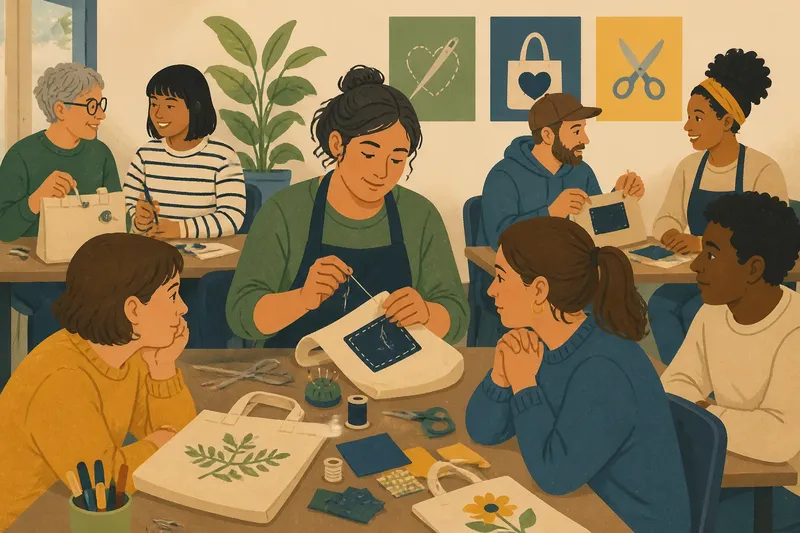
Say a neighborhood group wants to help residents repair and decorate worn fabric tote bags. Imagine that the group has a few confident menders, several people who can draw or print simple designs, and some attendees who have never used a needle. The organizers could run a skill swap, a demonstration, or a session that uses both. The useful choice depends on the intended result, not on which title sounds livelier.
Skill swap or demonstration begins with the learning goal
A skill swap treats participants as potential teachers as well as learners. Someone might show how to sew on a button, while another person shares a simple way to plan a fabric design. Contributions can be small: a tip, a short explanation, or a brief period of individual help counts as knowledge worth sharing.
A demonstration centers on a person showing a task to a group. The demonstrator can explain each decision as they work, such as why they choose a particular stitch or how they position a patch. Participants watch first and ask questions along the way; depending on the session, they may then try the technique themselves.
For the tote-bag gathering, the organizers’ first decision is what people should be able to do by the end. If the aim is to discover what neighbors know and let them trade useful techniques, a swap fits. If the aim is for beginners to see one repair from start to finish, a demonstration provides a clearer route.
A skill swap makes participant contributions part of the plan
Swaps suit groups with varied abilities and interests. A person who is new to sewing may still contribute by sketching a design, explaining how they choose washable fabric, or helping someone compare colors. This prevents the gathering from quietly dividing people into “experts” and “everyone else.”
The format also needs a workable way for people to meet. Organizers could set out tables for different skills, invite participants to name one thing they can show and one thing they hope to learn, or arrange short paired exchanges. A visible prompt such as “I can show” and “I’d like help with” gives people an easy opening without requiring a polished lesson plan.
In the invented tote-bag session, one resident could offer a button-sewing mini-lesson, another could demonstrate fabric markers, and a beginner could ask for help choosing a patch placement. The expected observable result is that participants exchange techniques and leave with a next action, even if not everyone completes a repair. The organizer should not promise that each person will master every skill; a swap is an exchange, not a certification program.
A demonstration gives beginners a shared starting point
A demonstration is useful when the task has a sequence that is easier to understand by watching. Seeing a demonstrator thread a needle, secure a knot, and make a few stitches can answer questions that are hard to resolve through conversation alone. One person’s clear view of the work matters more than a long list of techniques.
For this format, organizers should choose a task small enough to follow and make the materials visible. A large needle, contrasting thread, and a scrap of fabric can help a group see what is happening. The demonstrator can pause between stages, name common choices, and leave time for questions rather than racing through the work as if the audience were watching a cooking show at double speed.
In the hypothetical tote-bag gathering, a confident mender could show how to attach one patch, then invite attendees to practice on fabric scraps. The expected result is a common reference point: beginners see the same sequence and can ask about the same details. Participants with more experience may still benefit, but they will have fewer chances to teach unless the session deliberately makes room for their knowledge.
Choose the format that fits the group’s experience and aim
Use a skill swap when the group has several contributions to make and the aim is mutual exchange. Use a demonstration when a specific technique needs a clear model, especially if attendees have little prior experience. Neither format requires every participant to arrive with the same confidence or skill.
A mixed session can work when the organizers keep its parts distinct. For example, begin with a short demonstration of patching, then open a swap period where people share ways to select fabric, personalize a bag, or adapt the technique. The demonstration supplies a shared starting point; the swap lets participants shape what happens next.
That combination is less useful if the goal is simply to let people talk freely about their interests. In that case, a formal demonstration may take up space that could belong to conversation. Likewise, a swap can feel vague if attendees expect to learn one specific procedure and nobody has agreed to show it.
Prepare contributions without turning the gathering into a class
Organizers can ask contributors to name their skill, describe what a beginner can try, and identify any materials they need. This small amount of preparation helps match offers to requests while keeping participation flexible. A contribution might be a five-minute explanation rather than a full lesson.
For a demonstration, agree on the task and the visible stages in advance. Ask the demonstrator to bring a sample or practice material, and make sure there is room for people to see the work. For a swap, provide simple ways to find one another, such as cards, table signs, or a shared list of offers and requests.
For either format, check that the planned activity suits the venue and the materials. Follow product labels, manufacturer instructions, and local rules where they apply; consult a qualified professional if a proposed activity raises a safety concern. Keeping the session within familiar, low-risk craft tasks helps the group focus on learning rather than improvising around unsuitable equipment.
What should organizers decide before choosing a format?
How experienced should participants be for a skill swap?
They do not need matching experience, and beginners can contribute questions, ideas, or a skill from another area. Organizers should make clear that an offer can be modest and that nobody is expected to teach beyond their comfort level.
When is a demonstration better than a skill swap?
Choose a demonstration when one technique has a clear sequence and participants need to see it before trying. It is especially useful when several attendees share the same basic question and a common explanation will help them get started.
Can a gathering combine a swap and a demonstration?
Yes, if each part has a defined purpose and enough time. A short demonstration can introduce one technique, followed by a swap in which participants contribute related tips or learn from one another.
How can a beginner contribute without teaching?
A beginner can name a question, help prepare materials, offer a design idea, or explain what made a technique easier to follow. Participation is not limited to standing at the front and speaking with the confidence of a person who has never misplaced a needle.
Notice what the format makes possible
After the gathering, organizers can ask what people tried, what they shared, and what they would like to learn next. Those questions reveal whether the chosen format supported the intended kind of participation. If people learned a technique but had little chance to contribute, the next session might add a swap period; if offers and requests never met, a focused demonstration may be more useful.
For the tote-bag group, the right format depends on whether neighbors mainly need a visible model, a chance to trade skills, or both. A demonstration gives beginners a shared starting point; a skill swap gives participants more room to shape the session. Choose the structure that makes the next useful contribution easy, and let the group’s actual questions guide what it shares next.