From Noticeboard to Group Chat: How Community Invitations Changed
Community invitations moved from paper notices to group chats, changing who sees plans and how they travel. Learn to spot gaps and keep both channels useful.
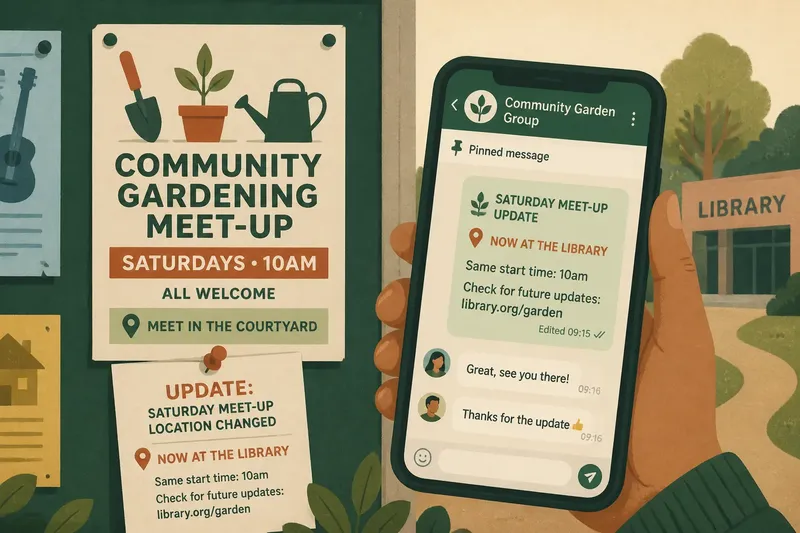
A community invitation on a noticeboard can reach someone who never checks the group chat; a message in the chat can change before the paper copy is even pinned up. Community invitations have shifted from fixed public notices toward fast, editable messages, and each format makes a different part of local life visible.
The change is not simply paper giving way to phones. It is a shift in who can see an invitation, who can pass it along, and which details are likely to survive the journey. Groups get into trouble when they treat one channel as a complete record of the other.
Paper notices made local activity visible in shared places
For a long time, a community noticeboard did more than announce a meeting. Its location—outside a library, inside a laundromat, or beside the entrance to a community hall—made the group’s presence visible to people already moving through the neighborhood.
A notice was usually stable once printed. That helped passersby take in the date and purpose at a glance, but made corrections awkward. If the room changed or an event was postponed, someone had to replace the sheet, add a clear correction, or accept that old information might stay on display.
Paper also asked people to remember what they had read. A phone number, tear-off tab, or short web address gave them a way to carry the invitation away. Without one, the notice might prompt interest and then vanish from memory somewhere between the bus stop and home.
Digital messages made invitations easier to revise and forward
Email lists, messaging apps, and social platforms let organizers send updates without returning to the same wall. A group chat can answer a question in the same place as the invitation, and members can forward the message to neighbors who are not on the original list.
That speed creates its own visibility problem. A message may appear between household logistics and work updates, then slip out of view. A forwarded copy can keep circulating after the organizer has corrected the original, leaving readers with two versions and no obvious way to tell which one is current.
Chat also makes participation look more immediate than it is. A stream of replies may suggest that everyone has seen the plan, although quiet readers may never react. A paper notice rarely gives organizers that misleading sense of confirmation; it just sits there, unhelpfully calm.
Why do community invitations get lost between formats?
Why does a noticeboard announcement reach the same people repeatedly?
People tend to pass familiar places as part of their routine, so a notice at one location reaches the people who use that route. Try placing copies at more than one relevant public location, with permission, and keep the wording and date consistent across them.
Why do group chat invitations disappear so quickly?
New messages push older ones out of view, especially in busy chats. Ask an administrator to pin the current invitation or repost it at a sensible interval, rather than sending repeated reminders that teach members to mute the conversation.
Why do forwarded messages contain outdated details?
A forwarded message is a copy, not a live link to the organizer’s latest version. Include a contact method or a stable page where readers can check the current date and location, and make any correction explicit in the channel where the original circulated.
Why do people assume a message was seen?
Delivery indicators and quick replies show activity, not universal attention. State how someone can ask a question or get an update without making a reaction emoji stand in for attendance.
Use each channel for what it can show clearly
A noticeboard is useful for steady visibility: an ongoing weekly gathering, a public drop-in, or a group seeking new members. A chat is useful for changes and coordination among people already connected. Neither has to carry every detail equally well.
Keep the invitation itself short enough to scan, then provide a reliable route to fuller information. On paper, that might be a readable web address or a phone contact. In chat, it might be one message with the time, place, purpose, and a link that leads to current details rather than an old image.
Imagine a neighborhood gardening group moves its Saturday meet-up from a courtyard to the library during rain. The organizer updates the pinned chat message and posts a small correction beside the original notice, naming the new location and where to confirm future changes. Someone who sees either version can find the current plan without guessing which channel to trust.
Keep the invitation trail legible
When plans change, identify what changed and what stayed the same. “Location changed to the library; same start time” is easier to act on than a fresh message that assumes everyone remembers the earlier one. Remove or mark obsolete notices when practical, and avoid quietly editing a post when readers may have already copied it.
For a recurring activity, distinguish the standing invitation from a one-time update. A regular notice can point to the usual pattern; a dated message can handle a cancellation or special arrangement. That separation reduces the chance that an old exception becomes the new rule by accident.
Community invitations now move between walls, inboxes, and chats, but the useful question remains concrete: can a person who encounters this message tell what is happening and where to verify a change? Treating community invitations as a trail rather than a single announcement helps people join without needing to be present in every channel. A brief correction, placed where the original audience can find it, often does more than another polished invitation.