A Shared Room, Ready for a Mixed-Activity Afternoon
Plan a shared room for a mixed-activity afternoon with clear areas for conversation, making and quiet breaks, so visitors can choose how to take part.
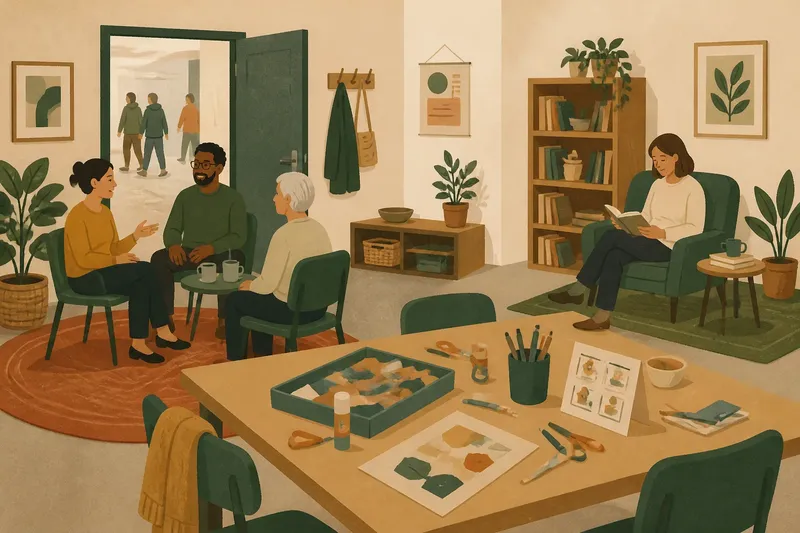
A shared room works better for a mixed-activity afternoon when conversation, making and quiet breaks each have a clear place. The arrangement matters more than matching furniture: a table crowded with supplies can make a casual chat feel like a workshop, while a quiet corner beside a running conversation may not feel quiet to anyone.
Plan the room around how people want to spend their time, not around a single activity everyone is expected to join. Three approaches are useful: a loose layout with distinct areas, a guided rotation between activities, or a quiet-first setup with optional activity nearby. Each suits a different group and kind of afternoon.
A shared room needs distinct activity areas
Begin by identifying what each area must let people do. The conversation area needs seats that face one another and enough space for someone to join without interrupting a task. The making area needs a stable surface, supplies within reach and a place for unfinished work. The quiet area needs some separation from both.
Use the room’s existing features before bringing in more furniture. A rug, bookcase or open doorway can suggest boundaries without turning the space into a maze. Keep entrances and routes between areas clear, and avoid placing chairs where a person has to pass directly through someone else’s work.
Give each area a small, visible cue. A tray of pencils and paper makes a making table legible; a few chairs with a small side table suggest conversation; a chair away from the main table can signal that taking a pause is welcome. Signs can help, but they should clarify the choice rather than sound like rules.
A loose layout suits drop-in afternoons
In a loose layout, all three activities are available at once and visitors move between them as they like. This works well when people will arrive at different times, when attendance is informal, or when some visitors may prefer to watch before joining in. Nobody needs to interrupt a group to ask when the next activity starts.
Its main advantage is flexibility; its main drawback is that the room can become lopsided. Everyone may gather around the making table, leaving the conversation area empty, or a lively discussion may spill into the quiet corner. Put the most social area near the entrance and the quiet seat at the farthest practical point from it.
Keep the making activity easy to enter and leave. Offer materials that can be put down without needing to explain a partially finished piece. A shared sheet of collage paper, for instance, allows a visitor to add one scrap and move on; a project that depends on a long sequence may make casual participation feel like an obligation.
A guided rotation suits groups that want shared time
A guided rotation gives people a chance to try each activity during a set gathering. It can suit a group that already knows one another and wants a common structure, or a session where the making activity benefits from a short demonstration. The host can explain the options and signal transitions, leaving people less uncertain about what to do next.
The cost is reduced freedom. A person absorbed in conversation may not want to move, and someone who needs a quiet pause may not be ready when the schedule says so. Build in unstructured time and make it acceptable to stay in one area or skip a round. The rotation should offer a path, not take attendance.
Choose activities that tolerate interruption. A short drawing prompt or a simple mending task is easier to pause than a project requiring continuous concentration. Keep instructions available on a card at the work table, so late arrivals can join without asking the host to repeat the opening explanation.
A quiet-first setup suits people who need an easy exit
A quiet-first arrangement puts the least stimulating option in the most protected part of the room, then places conversation and making farther toward the entrance or shared center. It suits gatherings where visitors may have different comfort levels, where the room is naturally echoing, or where attendance includes people who may want to observe rather than talk.
Quiet does not require a separate room. A chair angled away from the main table, a small stack of paperbacks, or a place to sit without being asked a question can make a meaningful difference. Avoid turning the area into a designated “time-out” spot; its purpose is ordinary choice, not a public signal that someone has a problem.
This layout can make the lively activities feel less central, so give them enough room to work without claiming the whole space. If conversation is likely to grow, use chairs in a compact cluster rather than spreading them along the room. For making, choose supplies that do not require loud tools or repeated movement across the quiet area.
How should you choose a room layout?
Which layout works for people arriving at different times?
A loose layout is usually easiest because each area is ready on arrival. Put a brief description of the activities near the entrance, so a late visitor can understand the choices without interrupting a conversation.
How can a making activity stay easy to join?
Choose a task that permits a small contribution and can be paused cleanly. Put shared supplies in a tray and leave a finished sample or short instruction card on the table, without implying that everyone must produce a complete object.
What should you do if conversation carries across the room?
Increase distance between the conversation cluster and the quiet seat, and avoid placing the quiet area in a corridor people use to reach other activities. If the room is still too noisy, offer a shorter pause option nearby rather than describing the space as silent.
Set the room up for movement and choice
Imagine a community room with one long table, a doorway opening onto a busy hall and a small bookcase along the far wall. The host could place paper and collage materials at one end of the table, arrange a few chairs near the doorway for conversation, and set a single comfortable chair beside the bookcase for a quiet break. The expected result is visible choice: visitors can see where to make, talk or pause, without crossing the work area to reach a seat.
Before people arrive, look at the layout from the doorway and from each activity area. Check that there is a clear route to the entrance, that a chair can be approached without moving someone’s materials, and that supplies are not blocking the place where people set down coats or bags. If the venue has rules about furniture, access or permitted materials, follow those rather than improvising around them.
Keep the welcome short and concrete: name the three areas, say that people may move between them, and point out where shared supplies belong. A host can then spend less time directing traffic and more time noticing whether a chair needs moving or a table needs clearing. The simplest choice is often the best fit: use a loose layout for drop-ins, a rotation for a group seeking a shared sequence, and a quiet-first arrangement when stepping away should feel especially easy.
A shared room for a mixed-activity afternoon does not need to make everyone comfortable in the same way. Its useful measure is whether a visitor can see a reasonable next choice, take it without asking permission, and change their mind without having to announce why.